简体中文
简体中文 English
 Español
Submit feedback
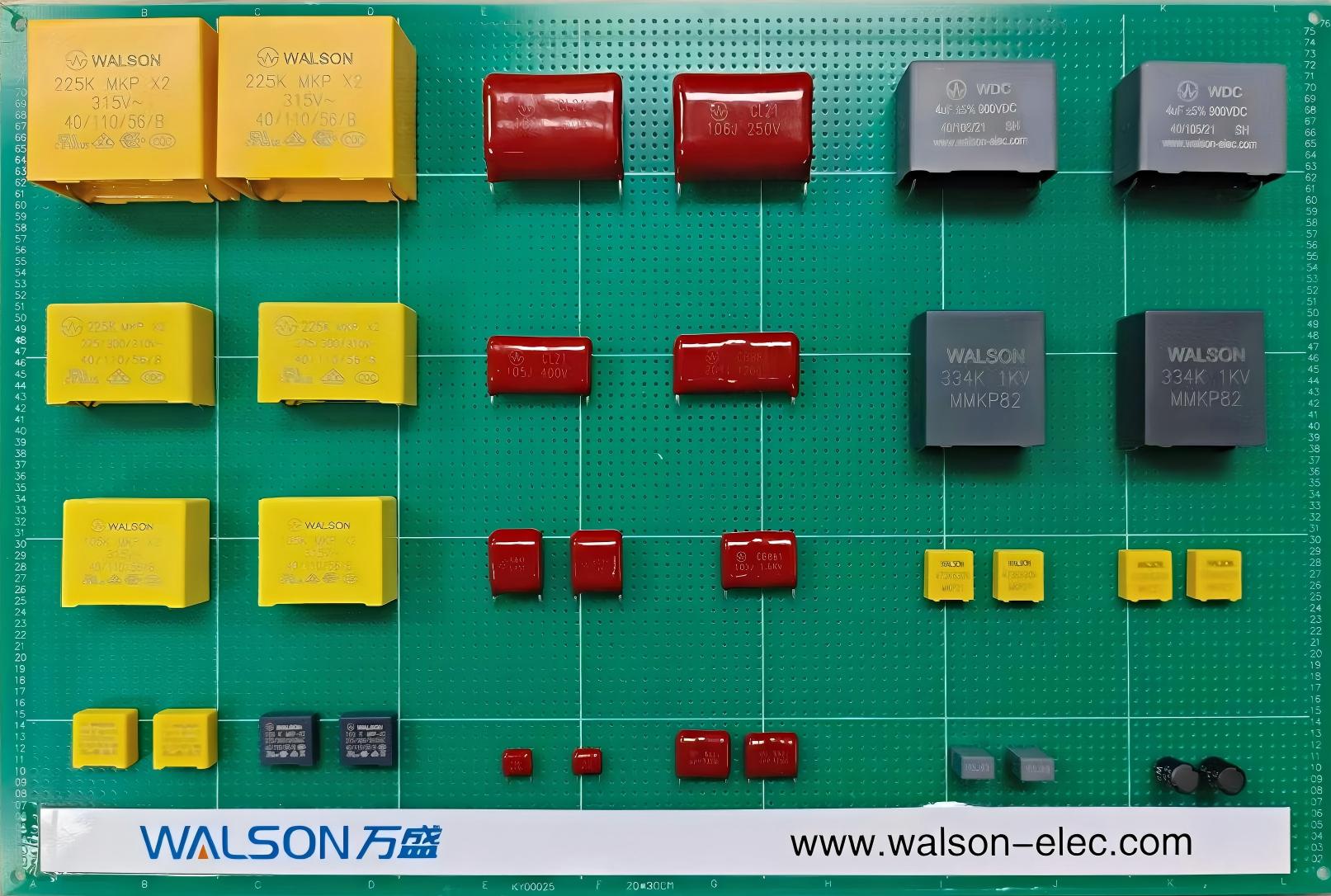
Understanding Film Capacitors in One Article: Core Knowledge from Materials to Structure
I. Core Material: Dielectric Thin Film
The dielectric film is the “heart” of a film capacitor, directly determining the upper limit of the capacitor’s basic performance. They are mainly divided into two categories:
1. Traditional (Non-Polar) Thin Films
Polypropylene (PP, BOPP):
- Performance characteristics: Extremely low loss (DF ~0.02%), stable dielectric constant, good temperature and frequency characteristics, and high insulation resistance. It is currently the thin film material with the overall performance and the widest range of applications.
- Applications: High-frequency, high-pulse, and high-current applications, such as inverters, switching power supplies, resonant circuits, and high-end audio crossovers.
Polyester (PET):
- Performance characteristics: High dielectric constant (~3.3), low cost, and good mechanical strength. However, it has relatively high losses (DF ~0.5%) and poor temperature and frequency characteristics.
- Applications: DC and low-frequency applications where there are requirements for capacity-to-volume ratio but not high requirements for loss and stability, such as consumer electronics, general DC blocking, and bypass.
Polyphenylene Sulfide (PPS):
- Performance characteristics: High temperature resistance (up to 125°C and above), dimensional stability, and lower loss than PET. However, the cost is higher.
- Applications: Automotive electronics, high-temperature surface mount devices (SMD), precision filters.
Polyimide (PI):
- Performance characteristics: The king of high-temperature resistance (up to 250°C or higher), but it is expensive and difficult to process.
- Applications: Aerospace, military, high-temperature environments.
2. Emerging (Polar) Thin Films - Representing High Temperature and High Energy Density
Polyethylene Naphthalate (PEN):
- Its performance is between that of PET and PPS, and its heat resistance is better than that of PET.
Polybenzoxazole (PBO):
- With ultra-high heat resistance and ultra-high dielectric strength, it is a potential material for future electric vehicle drive film capacitors.
Fluoropolymers (such as PTFE, FEP):
- It has high-frequency characteristics and extremely low loss, but it is difficult to process and has high cost, so it is used in special high-frequency microwave circuits.
Core Trade-offs in Material Selection:
- Dielectric Constant (εr): Affects volumetric efficiency (the volume required to achieve the same capacitance).
- Loss Tangent (tanδ/DF): Affects efficiency, heat generation, and Q value.
- Dielectric Strength: Affects withstand voltage.
- Temperature Characteristics: Affect the operating temperature range and capacity stability.
- Cost and Processability: Impact on commercialization.
II. Core Structure: Metallization Technology and Electrodes
The essence of thin-film capacitors lies in how to build electrodes on thin films, and from this, products with different characteristics can be derived.
1. Electrode Type
Metal Foil Electrode:
- Structure: Metal foil (usually aluminum or zinc) is directly laminated and wound with a plastic film.
- Advantages: Strong ability to carry high current (low electrode resistance), good overvoltage/overcurrent tolerance.
- Disadvantages: Large size, no self-healing ability.
Metallized Electrodes (Mainstream Technology):
- Structure: Under high vacuum, metal (aluminum, zinc, or their alloys) is vaporized onto the surface of a thin film in atomic form to form an extremely thin metal layer with a thickness of only tens of nanometers.
- Advantages: Small in size and high in specific volume, its “self-healing” capability. When a dielectric material partially breaks down, the instantaneous high current generated at the breakdown point causes the surrounding thin metal layer to vaporize and evaporate, thereby isolating the defect and restoring the capacitor’s performance.
2. Key Technologies for Metallized Electrodes (Improving Reliability)
Edge Leaving and Thickening the Edge:
- Edge Leaving: During vapor deposition, a blank area is left at the edge of the film to prevent the two electrodes from short-circuiting due to contact at the edge after winding.
- Thickened Edges (Current Fuse Technology): The metal layer on the contact surface (gold-plated surface) of the electrode is thickened, while the metal layer in the central active area remains extremely thin. This ensures low contact resistance at the contact surface and results in less energy being required for self-healing, making it safer and more reliable.
Split Electrode Technology:
- Mesh/Striped Segmentation: Dividing the vapor-deposited electrode into multiple small, mutually insulated areas (like a fishing net or stripes).
- Advantages: It localizes potential self-healing, greatly limiting the self-healing energy and area, preventing capacitance loss caused by large-area self-healing, and significantly improving the durability and safety of capacitors. This is a standard technology for high-voltage, high-power capacitors.
III. Structural Design: Winding and Lamination
1. Winding Type
Process: Two or more layers of metallized thin films are wound into a cylindrical core like a roll.
Types:
- Inductive Winding: Electrodes are led out from both ends of the core, resulting in a relatively large inductance.
- Non-Inductive Winding: The electrodes extend from the entire end face of the core (the metal end face is formed by a gold spraying process). The current path is parallel, and the inductance is extremely low, making it suitable for high-frequency, high-pulse applications.
Advantages:
- Mature technology, wide capacity range, and easy to manufacture.
Disadvantages:
- Not a flat shape, which may result in low space efficiency in some PCB layouts.
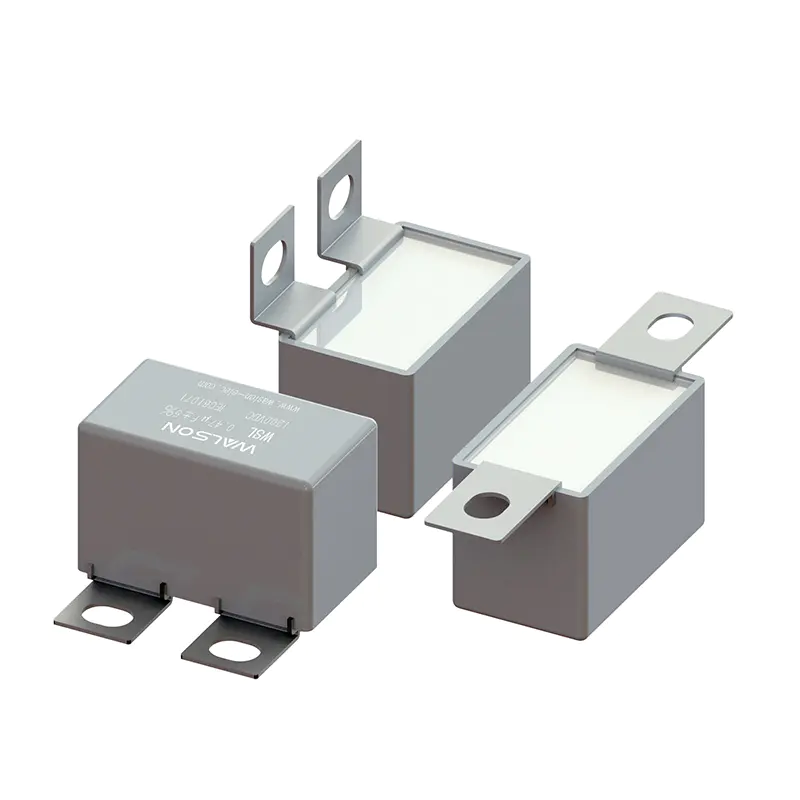
2. Laminated Type (Single-Piece Type)
Process: The thin films with pre-deposited electrodes are stacked in parallel, and then the electrodes are alternately led out through a connection process to form a “sandwich” multilayer structure.
Advantages:
- Extremely low inductance (minimum ESL), suitable for ultra-high frequency applications.
- Regular shape (square/rectangular), suitable for high-density SMT placement.
- Better heat dissipation.
Disadvantages:
- The process is complex, and it is difficult to achieve large capacity/high voltage, and the cost is relatively high.
Applications:
- High-frequency radio frequency circuits, decoupling, microwave applications.
IV. Conclusion: Synergistic Effects of Materials and Structures
The performance of film capacitors is the result of a precise synergy between their material properties and structural design.
| Application Scenarios | Typical Material Combinations | Typical Structural Technology | Core Performance Pursued |
|---|---|---|---|
| High Frequency/Pulse/High Current (e.g., IGBT snubber) | Polypropylene (PP) | Seamless winding + metallization (segmented electrodes) | Low loss, low inductance, high dv/dt capability, and high self-healing reliability |
| High Voltage/High Power (e.g., new energy, power electronics) | Polypropylene (PP) | Seamless winding + metallization (thickened edges + fine segmentation) | High dielectric strength, high self-healing safety, long lifespan, and low loss |
| High-Temperature SMD (e.g., automotive electronics) | Polyphenylene Sulfide (PPS) | Laminated structure or miniaturized winding | High temperature stability, dimensional stability, suitable for reflow soldering |
| High Capacity-to-Volume Ratio (consumer electronics) | Polyester (PET) | Conventional metallized winding | Low cost, small size, sufficient capacity |
| Ultra-High Frequency Microwave (radio frequency circuit) | Polypropylene (PP) / PTFE | Layered structure | Extremely low ESL, ultra-high Q value, and stable high-frequency characteristics |
Future Development Trends:
Materials Innovation: Develop novel polymer films with higher temperatures (>150°C) and higher energy storage densities (high εr, high Eb).
Refined Structure: More precise control of vapor deposition patterns (nanoscale segmentation) enables better self-healing control and performance.
Integration and Modularization: Integrating multiple capacitors with inductors, resistors, etc., into a single module to provide a holistic solution for power electronic systems.