简体中文
简体中文 English
 Español
Submit feedback
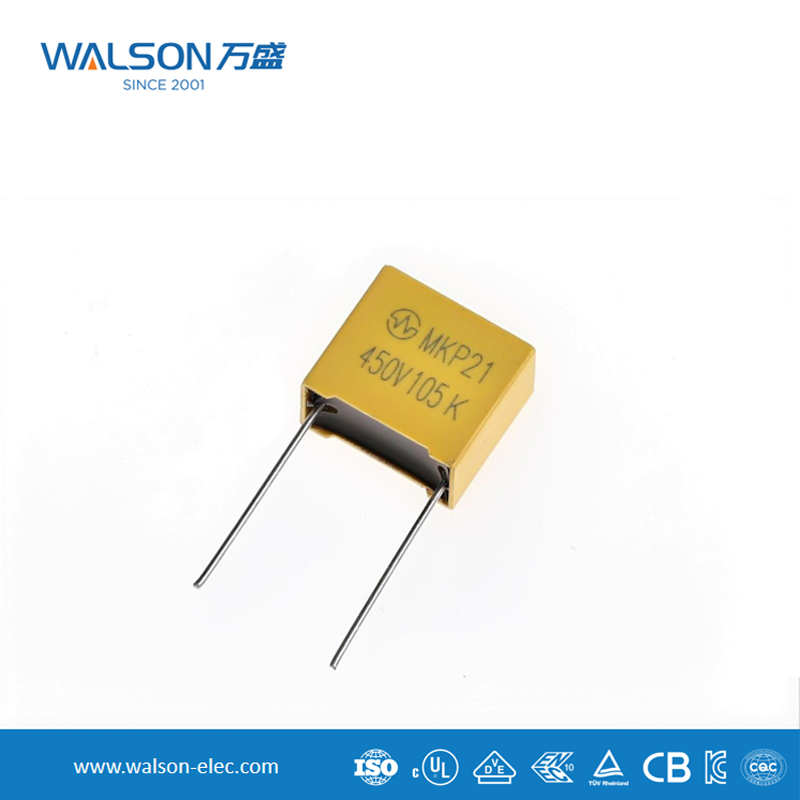
Understanding Heat Generation in Metallized Film Capacitors
Understanding Heat Generation in Metallized Film Capacitors
As metallized film capacitors are widely used in power electronics, renewable energy systems, and automotive applications, their thermal performance has become a critical concern for engineers and equipment manufacturers. Where exactly does the heat come from inside these essential components? The answer lies in three primary sources.
Metal Losses
Every metallic part within a capacitor contributes to heat generation. The metallized electrodes, internal connecting wires, end-sprayed metal layers (Schoopage layers), solder joints, and terminal leads all possess inherent electrical resistance. These resistances collectively form an equivalent series resistance (ESR), which produces power losses when current flows through the capacitor.
These losses manifest in various forms—electrode resistance loss, lead resistance loss, contact resistance loss at sprayed ends, and soldered joint losses—all of which are categorized as metal losses. While individual resistances are small, they become significant under high-frequency or high-current operating conditions.
Dielectric Losses
When a voltage is applied across a dielectric material, a portion of electrical energy is inevitably converted into heat—a phenomenon known as dielectric loss. This loss is primarily divided into two types:
Conductance loss: All dielectrics exhibit some degree of electrical conductivity, allowing a leakage current to flow. In high-quality dielectrics, this current is minimal, but if manufacturing processes are substandard—allowing moisture or impurities to contaminate the material—insulation resistance drops significantly, leading to increased conductance loss and higher temperatures.
Polarization loss: Under alternating current (AC) voltages, the dielectric undergoes repeated polarization cycles. Electrons, ions, dipoles, and other polar groups constantly reorient themselves in response to the changing electric field. This motion must overcome thermal molecular resistance, thereby consuming electrical energy and converting it into heat. The degree of polarization loss depends heavily on the dielectric's polarity, ambient temperature, and operating frequency—with more polar materials generating greater losses.
Partial Discharge Losses
Under high voltage stress, if microscopic air voids remain trapped between dielectric layers, the air within these voids can ionize due to its lower breakdown strength, triggering partial discharges. Edge regions of capacitor electrodes, where electric field concentration is more intense, are also susceptible to this phenomenon.
Partial discharges not only consume active power and generate additional heat but also produce chemically aggressive gases such as ozone and nitrogen oxides. These byproducts gradually corrode the dielectric material, accelerating its degradation and shortening the capacitor's service life.
Thermal Management Matters
Understanding these heat sources is the first step toward designing more reliable capacitors and improving system-level thermal management. From material selection and manufacturing precision to operating voltage and frequency derating, every factor plays a role in controlling temperature rise—and ultimately ensuring long-term performance and safety.