简体中文
简体中文 English
 Español
Submit feedback
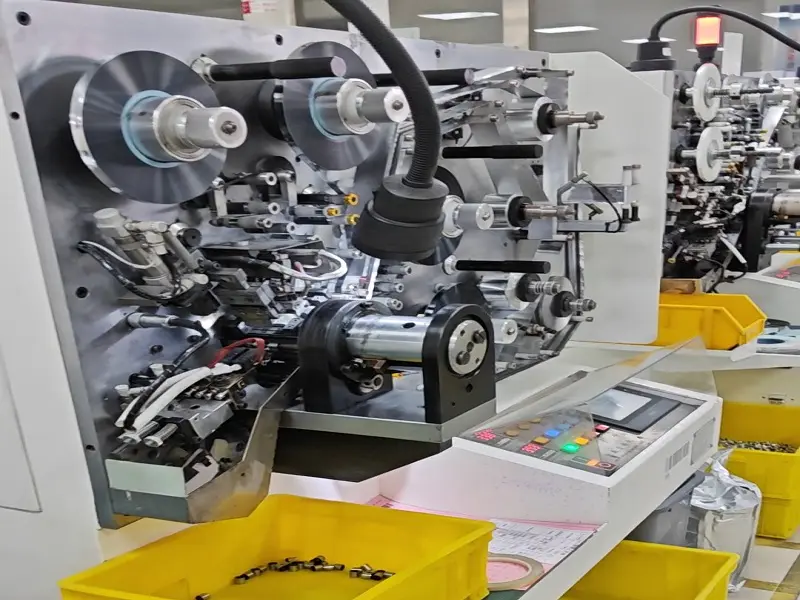
Behind the Scenes: The 10-Step Manufacturing Journey of Film Capacitors for High-Power Applications
Film capacitors are widely used in high-power applications such as EV charging and renewable energy systems due to their high dielectric strength. The main manufacturing processes are as follows:
1.Metallizing: A nano-thick metal layer (e.g., zinc-aluminum) is vacuum-deposited onto the film. This layer enables self-healing—localized breakdowns isolate faults without failing the entire capacitor.
2.Slitting: The wide film is precisely cut into required widths. Edges must be clean and burr-free to prevent short circuits.
3.Winding: Two film layers are wound into a cylindrical core with offset edges, exposing the metal layers on both ends for electrical connection.
4.Flattening: The round core is pressed into a flat shape to improve space efficiency and heat dissipation.
5.Schooping (End Metallization): Molten metal (e.g., zinc) is sprayed onto both ends of the core, forming conductive end faces that connect all internal electrodes in parallel.
6.Stress Relieving: Heat treatment removes internal film stresses, ensuring stable capacitance.
7.Healing (Activation): A voltage higher than the rated value is applied to actively break down and isolate defects, improving reliability.
8.Terminal Welding: External terminals are firmly attached to the core electrodes using resistance or laser welding.
9.Coating: An insulating varnish is applied to enhance moisture and insulation resistance.
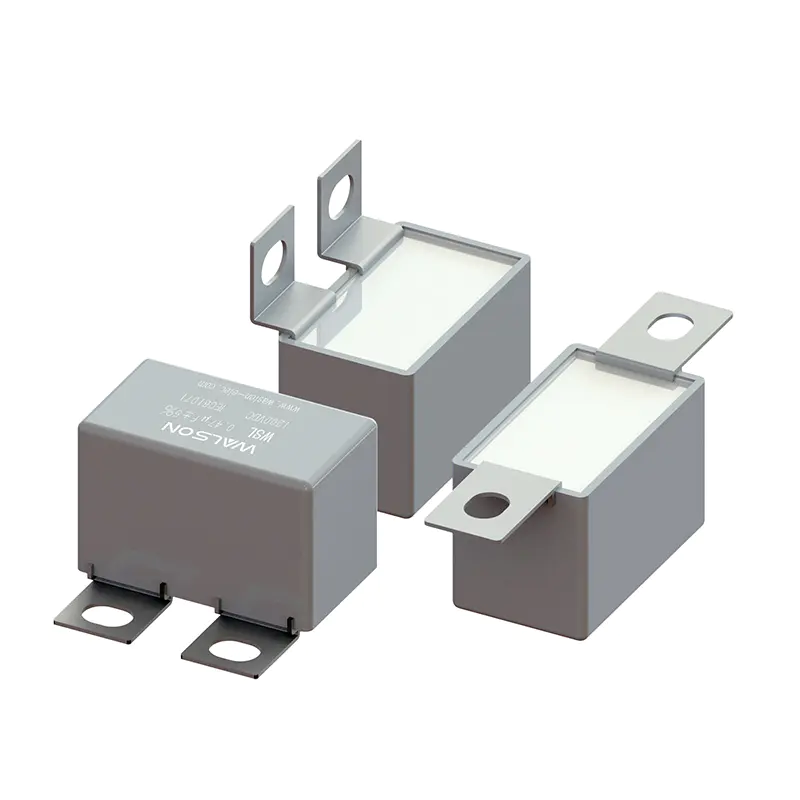
10.Potting/Molding: The core is placed in a PPS case and potted with epoxy resin for ultimate environmental and mechanical protection.
After these steps, the capacitors are tested and shipped.