简体中文
简体中文 English
 Español
Submit feedback
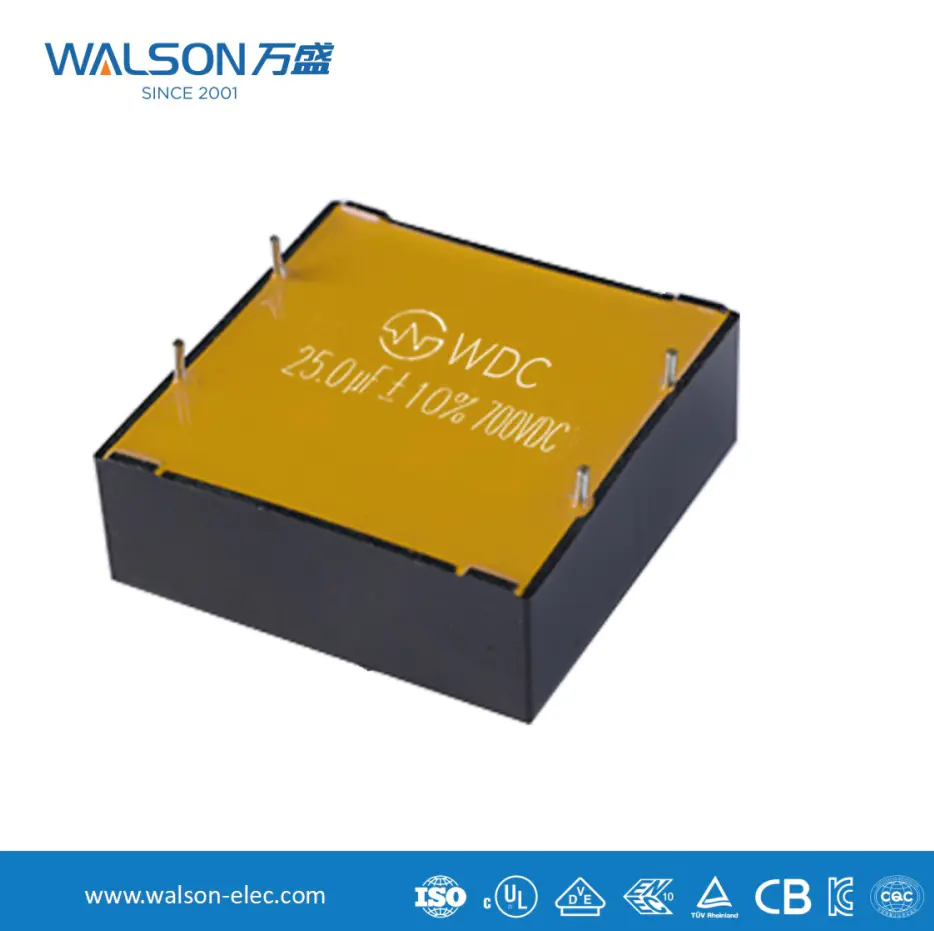
DC Link Capacitor Function and Selection Guide
I. Core Functions of DC Link Capacitors
DC link capacitors are typically located between the rectifier (or other DC source) and the inverter, and are key components in equipment such as frequency converters, inverter power supplies, and UPS. Their main functions can be summarized in the following four points:
1. Stabilize DC bus voltage (voltage regulation)
Function : Inverters (such as IGBTs) switch at high frequencies, drawing highly pulsating current from the DC bus. This results in significant ripple in the DC bus voltage.
The behavior of a capacitor : When the switching transistor is turned on and the current increases, the capacitor discharges , providing instantaneous energy to the load and preventing a sudden drop in bus voltage; when the switching transistor is turned off, the capacitor charges , absorbing energy from the power source and preventing a surge in bus voltage. It acts like a "reservoir," smoothing out fluctuations in the flow (current) and maintaining a stable water level (voltage).
2. Provide instantaneous peak current (provide reactive power)
Application : Modern motor drives require rapid dynamic response. When the load suddenly increases, the inverter needs to provide a large current instantaneously. Due to the parasitic inductance of the DC power supply and front-end lines, they cannot provide such a large current instantaneously.
Capacitor behavior : Due to their low internal resistance (ESL/ESR), capacitors can release their stored energy very quickly, providing the inverter with the required instantaneous peak current and ensuring the drive's fast response capability.
3. Absorbs high-frequency noise and ripple (filtering)
Function : The rapid switching on and off of switching devices generates high-frequency switching noise, which is radiated or conducted out through the line.
Capacitor behavior : DC link capacitors provide a low-impedance loop for these high-frequency noise components, allowing them to be absorbed locally, preventing noise interference to the upstream rectifier circuit or power grid, and also preventing it from affecting the downstream control circuit.
4. Suppress inductor energy feedback
Function : In motor drive, when the motor is in the generator state (such as braking or lowering heavy objects), energy will be fed back from the motor side to the DC bus.
The behavior of a capacitor : A capacitor can absorb this feedback energy, preventing the DC bus voltage from being pumped too high, thereby protecting the switching devices from overvoltage breakdown. (In cases of severe energy feedback, a braking resistor and braking unit are usually required.)
II. Key Points for Selecting DC Link Capacitors
When selecting a DC link capacitor, the following key parameters need to be considered:
1. Rated voltage
Calculation : The voltage must be higher than the possible voltage of the DC bus. For example, for a 380VAC three-phase input, the average DC voltage after rectification is approximately 540VDC. Considering factors such as grid fluctuations and pump-up voltage, capacitors with a rated voltage of 630VDC or 700VDC are typically selected.
Margin : Generally, a voltage margin of 15%-20% is required to ensure long-term reliability and cope with voltage spikes.
2. Capacitance
Function : The capacitance value determines a capacitor's ability to store energy and stabilize voltage. The larger the capacitance value, the better the voltage regulation effect and the smaller the voltage ripple.
Estimation method : There are complex formulas for calculation, but a common rule of thumb is that approximately 100μF - 200μF of capacitor is needed for every 1kW of inverter output power . For example, a 15kW inverter typically uses 1500μF - 3000μF of DC link capacitor.
Influencing factors include system power, switching frequency, allowable voltage ripple factor, and load inertia. A higher switching frequency allows for a relatively smaller required capacitor.
3. Rated ripple current
Definition : The effective value of the continuous alternating current that a capacitor can withstand. This is a key indicator for measuring capacitor heating.
Importance : If the actual ripple current exceeds the capacitor's rated value, it will cause severe overheating inside the capacitor, drying out of the electrolyte, a sharp reduction in lifespan, and even thermal breakdown.
Selection principle : The effective value of the total ripple current flowing through the capacitor must be calculated or simulated, and it must be ensured that the rated ripple current of the selected capacitor is greater than the actual ripple current , with a certain margin. In high-frequency applications, this is a parameter that is as important as, or even more important than, the capacitance.
4. Equivalent series resistance (ESR) and equivalent series inductance (ESL)
ESR : The main factor causing losses and heat generation in capacitors. The smaller the ESR, the lower the loss and the better the filtering performance at high frequencies.
ESL (Effective Low Voltage): Limits the high-frequency characteristics of a capacitor. When the frequency exceeds its self-resonant frequency, the capacitor becomes inductive and loses its capacitive function. To reduce ESL, multi-pin, multi-layer, or flat row pin designs are typically used.
5. Lifespan
Key factor : For electrolytic capacitors, lifespan is their core performance indicator. Lifespan is mainly affected by the temperature of internal hot spots .
Calculation : Follow the "10-degree rule," which means that for every 10°C decrease in operating temperature, the lifespan doubles. Manufacturers will provide the rated lifespan at the operating temperature (e.g., 105°C/2000 hours).
Selection considerations : Select capacitor models with sufficient lifespan based on the expected service life of the equipment and the ambient temperature.